
Visit the GLPI website
The official site of the GLPI project, published by Teclib’. Opens in a new tab — hold Ctrl (⌘ on a Mac) or middle-click to keep it in the background.
glpi-project.orgGLPI is an open-source IT service management and asset management platform. It combines a service desk with a full CMDB, so the ticket a user raises is linked to the machine, the licence, the contract and the supplier behind it.
For an IT department that has to answer audit questions about what it owns, where it is and who touched it last, that link between ticket and asset is the whole point. We deploy GLPI inside your network, connect it to your directory, and configure the inventory automation so the asset register maintains itself rather than decaying the moment someone stops updating a spreadsheet.
Who it’s for
IT departments and internal helpdesks that need ticketing and asset control in one system.
- Banks and financial institutions carrying an internal audit and regulatory reporting obligation
- Organisations tracking hardware, software licences, contracts and warranties across multiple branches
- IT departments that need an ITIL-shaped process without an enterprise ITSM licence cost
- Any organisation where ‘what do we actually own’ currently has no reliable answer
What we deliver
A working service desk and a populated asset register, handed over with your staff trained to run it.
Installation and hardening
Deployment on your servers or VMs, with the web tier, database and file storage separated and secured to your standards.
Directory integration
LDAP or Active Directory authentication and group mapping, so entitlements follow your existing organisational structure.
Inventory automation
Agent-based and network discovery so hardware and software inventory populates and refreshes without manual entry.
Workflow configuration
Ticket categories, SLAs, escalation paths and approval flows modelled on how your department actually escalates.
Licence and contract tracking
Software licence counts, renewal dates and supplier contracts held as tracked assets with expiry alerting.
Migration
Import of existing asset registers and open tickets from spreadsheets or a legacy tool.
Plugin configuration
Official plugins for reporting, compliance and inventory, configured and documented rather than left at defaults.
Training and handover
Sessions for agents, for administrators and for the person who will own the system after we leave.
On-premises versus cloud
Every criterion below is one your auditors will ask about. This is why we deploy inside your network by default.
| Criterion | On-premises, on your infrastructure | Public cloud / SaaS |
|---|---|---|
| Security | You control the firewall, the encryption keys, the access policy and the audit trail. | Shared infrastructure and a provider-defined security boundary. |
| Privacy | Data never leaves your network perimeter. | Data is stored and processed on third-party systems under their terms. |
| Autonomy | Full customisation, your upgrade schedule, no vendor lock-in. | Provider-driven roadmap and forced upgrade windows. |
| Integrity | You define backup, retention and recovery, and you test them. | You inherit the provider’s backup policy and their definition of acceptable loss. |
| Continuity | Service survives loss of internet connectivity; it runs on your intranet. | An outage or a commercial dispute at the provider becomes your outage. |
| Cost | Capital cost plus support; no per-seat escalation as headcount grows. | Per-user subscription that grows with your organisation. |
Asset and infrastructure inventory is a map of your estate. It is precisely the data set you would least like to be held outside your perimeter.
How it connects to the rest of your stack
Nothing we deploy is meant to stand alone. These are the joins we build as part of the same engagement.
- Monitoring — Zabbix alerts raise GLPI tickets automatically, so an infrastructure event becomes a tracked, assigned piece of work rather than an email someone missed.
- Certificate management — SSL/TLS certificates are held as GLPI assets with expiry dates, which turns renewal into a scheduled ticket instead of an outage.
- Issue tracking — Defects found by IT staff can be handed to the development-facing tracker without re-keying, keeping one record of the problem.
- Project delivery — Larger changes surfaced through the service desk can be escalated into governed projects rather than absorbed silently as unplanned work.
Engagement summary
Questions we’re usually asked
Can GLPI replace our existing service desk?
In most cases yes — it covers incident, request, problem and change, with SLA tracking and reporting. The honest constraint is that if your current tool drives heavily customised automation, we scope that explicitly during assessment rather than promising a like-for-like replacement up front.
How does inventory get into the system?
Two ways, usually both: an agent installed on managed machines, and network discovery for devices that cannot take an agent. Existing registers are imported during migration.
Do we depend on you afterwards?
No. The system is yours, the software is open source, and we train your staff to administer it. A support agreement is available if you want it, not required for the system to keep running.
Where ITIL fits, and why we do not sell it
GLPI is built along ITIL lines. Its incident, request, problem and change records, its service catalogue and its CMDB are the same objects the framework describes — which means that configuring GLPI properly is, in practice, adopting ITIL’s service-management shape.
We name that rather than market it. ITIL is not a service on this site because there is nothing to sell you: you inherit the discipline by running a service desk correctly, and the platform already encodes it. What we do is configure the categories, priorities, approval paths and SLA rules so that the shape matches how your organisation actually escalates, rather than leaving vendor defaults in place.
The contrast with PRINCE2 Agile is deliberate. Project governance has a section of its own because tailoring it is explicit, chargeable work that somebody has to do. Service governance does not, because it arrives with the tool. Both are frameworks; only one of them is a project.
The join between them is worth watching: a change approved at a PRINCE2 stage boundary should become an ITIL change record when it reaches production. That handover is where most organisations lose the audit trail, and it is one of the first things we configure.
GLPI in use
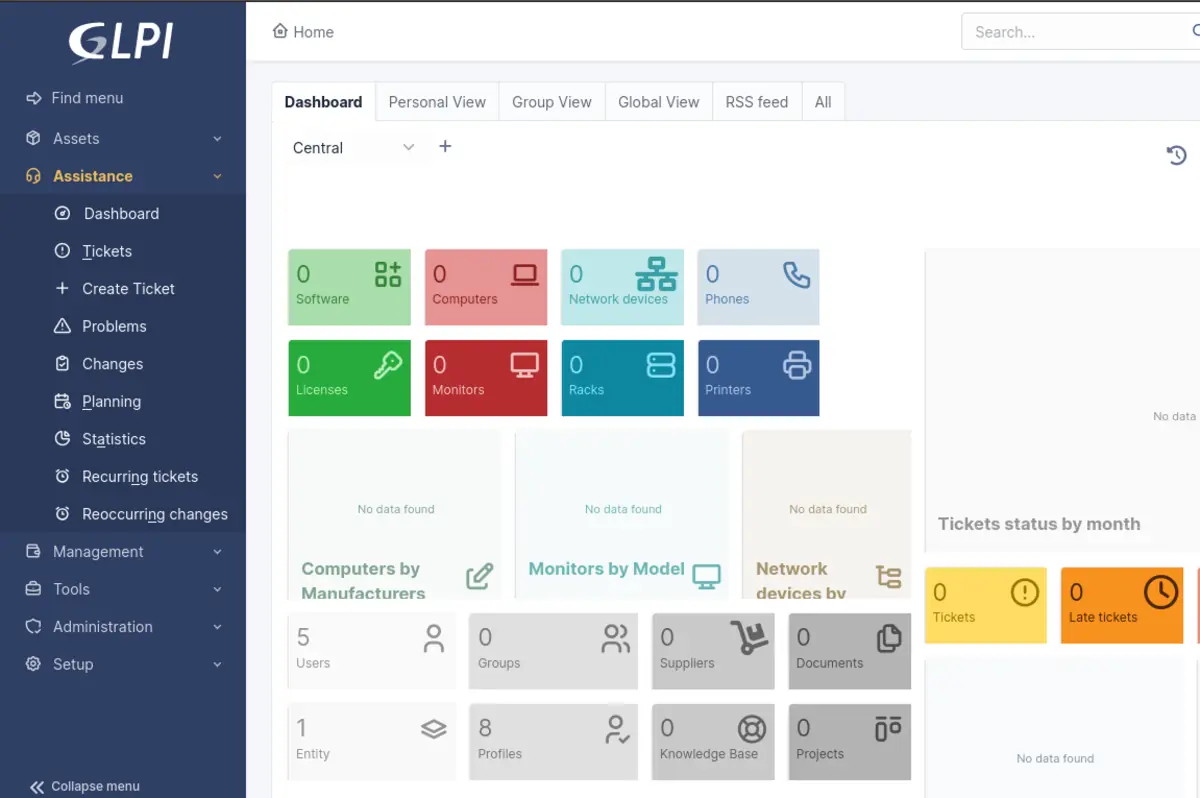


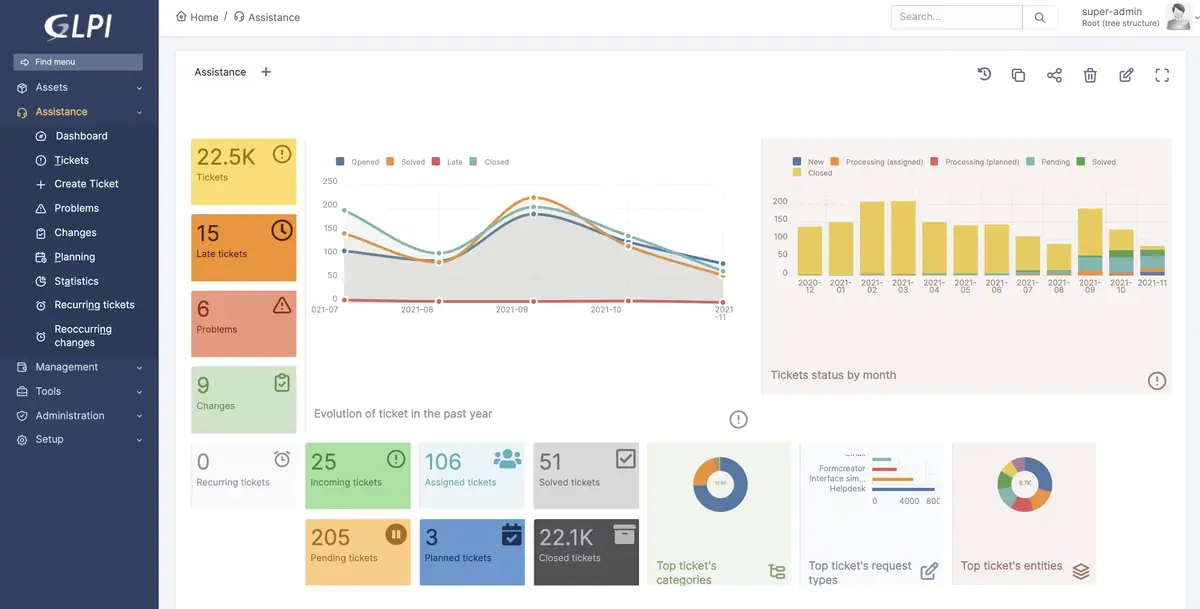
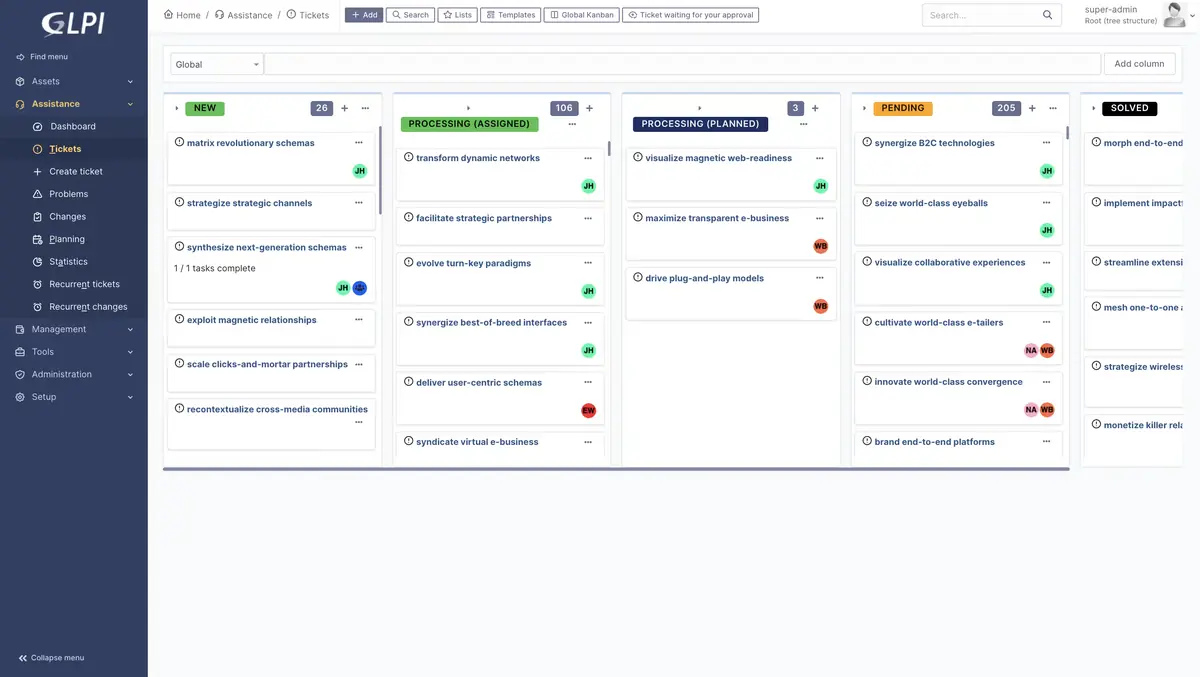
Screenshots from the GLPI project, shown to illustrate the platform we deploy and configure.
Under PRINCE2 governance
GLPI’s strength appears when a PRINCE2 project involves IT infrastructure, assets, services and operational transition. It is least useful for agile software development and most useful at the point most projects handle worst: the end.
Closing a Project requires moving the project’s products into operational use. That is exactly what GLPI is for — the servers, virtual machines, network equipment, software, users, contracts, support tickets and maintenance the project just created become a maintained operational record rather than tribal knowledge held by whoever built them.
- Configuration items and the relationships between them
- Servers, virtual machines and network equipment
- Applications, licences and support contracts
- Users, incidents and ongoing maintenance
How this compares with the other platforms we deploy, and which one fits which obligation, is on Choosing Between Our Platforms.