

MantisBT is a focused issue and defect tracker. It does one job — record a problem, route it, track it through a defined lifecycle, and leave an auditable trail — and it does that job without the overhead of a full agile planning suite.
That focus is the reason to choose it. Where a defect has to be traceable from report to fix to verification for regulatory reasons, a lighter tool with rigorous workflow control and clean permissions is easier to defend in an audit than a heavier one with more surface area.
Who it’s for
Teams with a formal defect-tracking obligation rather than a general project-planning need.
- QA and testing departments that need every defect to have an auditable lifecycle
- Software vendors handling client-reported bugs across multiple customer accounts
- Support and maintenance teams tracking issues against systems already in production
- Organisations with traceability requirements — safety-critical, regulated or contractual
What we deliver
A tracker configured to your defect lifecycle, with permissions that hold up under scrutiny.
Installation and hardening
Deployment on your infrastructure with secure defaults and mail configuration.
Workflow customisation
Status transitions, required fields and resolution categories matching your defect lifecycle rather than the shipped default.
Permission model
Project-level and role-level access so client A never sees client B’s defects, and reporters see only what they should.
Custom fields
Severity, reproducibility, affected version, environment and any regulatory reference your process requires.
Notification rules
Who is told what, when — configured so the tracker is useful rather than ignored.
Migration
Import of open defects and history from an existing tracker or spreadsheet.
Reporting
Defect ageing, resolution rate and per-release quality reporting.
Training and handover
Reporter, developer and administrator training.
On-premises versus cloud
Every criterion below is one your auditors will ask about. This is why we deploy inside your network by default.
| Criterion | On-premises, on your infrastructure | Public cloud / SaaS |
|---|---|---|
| Security | You control the firewall, the encryption keys, the access policy and the audit trail. | Shared infrastructure and a provider-defined security boundary. |
| Privacy | Data never leaves your network perimeter. | Data is stored and processed on third-party systems under their terms. |
| Autonomy | Full customisation, your upgrade schedule, no vendor lock-in. | Provider-driven roadmap and forced upgrade windows. |
| Integrity | You define backup, retention and recovery, and you test them. | You inherit the provider’s backup policy and their definition of acceptable loss. |
| Continuity | Service survives loss of internet connectivity; it runs on your intranet. | An outage or a commercial dispute at the provider becomes your outage. |
| Cost | Capital cost plus support; no per-seat escalation as headcount grows. | Per-user subscription that grows with your organisation. |
How it connects to the rest of your stack
Nothing we deploy is meant to stand alone. These are the joins we build as part of the same engagement.
- Post-migration verification — Data discrepancies found after a database migration are logged and tracked formally rather than handled over email.
- Service desk — Issues escalated by the helpdesk arrive in the tracker with their original context intact.
- Project delivery — Defects that require planned work rather than a hotfix are promoted into the project backlog with the link back to the original report preserved.
Engagement summary
MantisBT in use

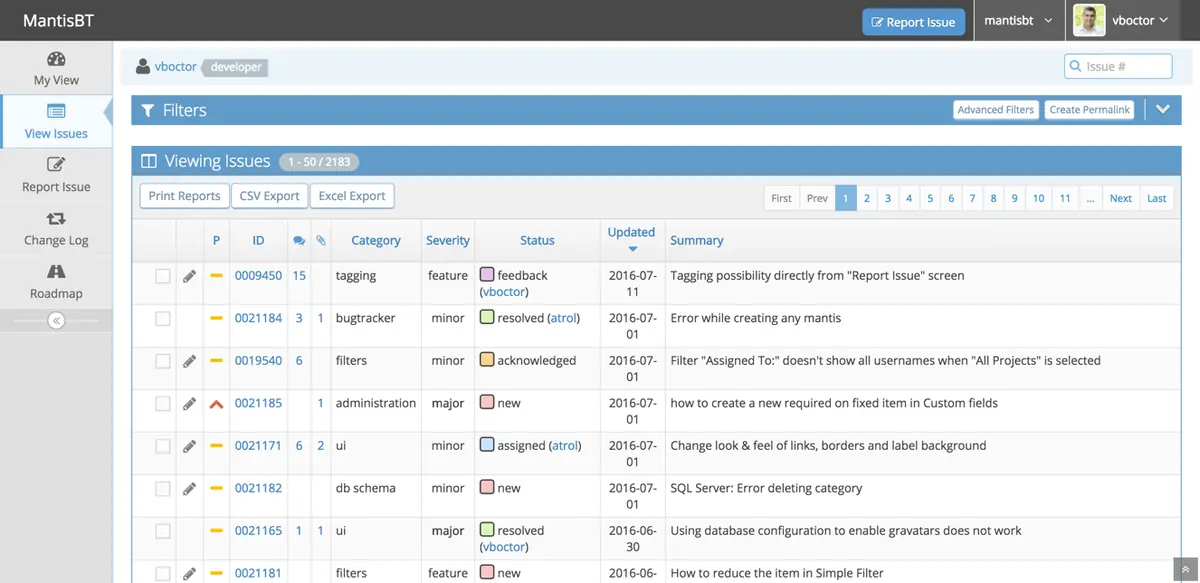
Screenshots from the MantisBT project, shown to illustrate the platform we deploy and configure.